

Dating someone with strongly narcissistic behaviors can change the way you think about yourself, relationships, and even ordinary conversations. Over time, repeated criticism, manipulation, lack of empathy, or constant pressure to prioritize one person’s needs can make you question instincts that once felt natural.
It is important to use the word carefully. Narcissistic Personality Disorder is a clinical diagnosis, and only a qualified professional can determine whether someone meets the criteria. You do not need a diagnosis, however, to recognize that a relationship pattern is harmful.
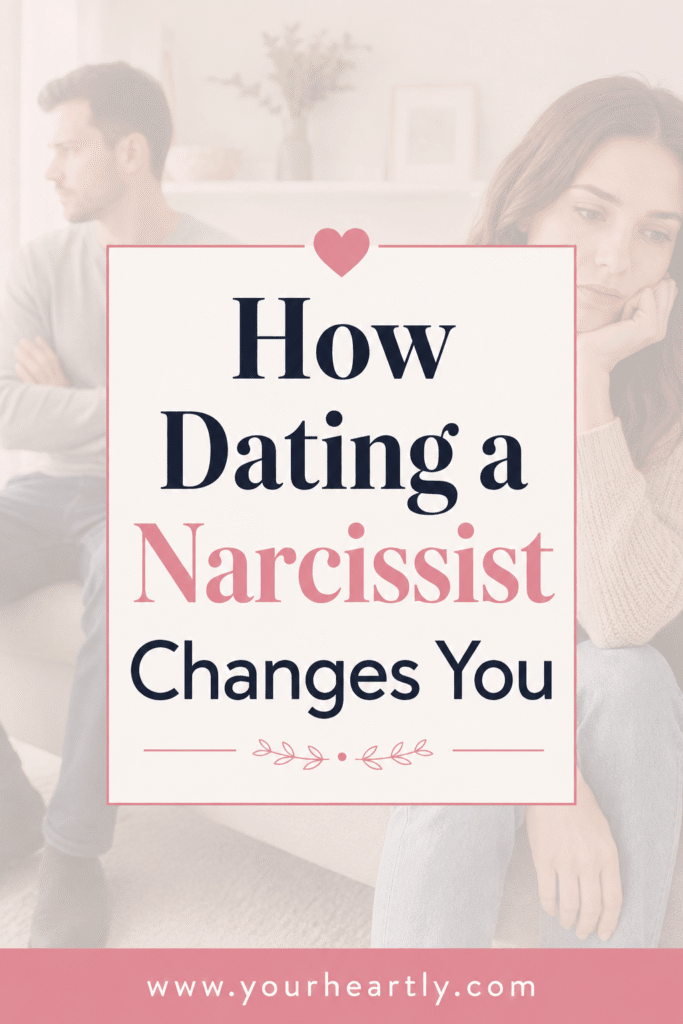
If you have been involved with someone who constantly needed admiration, refused accountability, controlled the emotional atmosphere, or made your feelings seem unimportant, you may notice changes in yourself long after individual arguments are over. Understanding those changes can help you separate your current reactions from the patterns you learned inside the relationship.
1. You Start Doubting Your Own Judgment
Repeated denial and contradiction can make you question what you clearly remember. You may bring up something hurtful and hear that it never happened, that you are exaggerating, or that you completely misunderstood the situation.
After enough conversations like this, you can begin checking yourself before you even speak. You wonder whether your memory is accurate, whether your reaction is unreasonable, or whether you are simply “too sensitive.”
This self-doubt can spread beyond the relationship. Decisions that once felt simple may suddenly require reassurance from friends because trusting your own interpretation no longer feels safe.
Rebuilding confidence often starts with small acts of self-trust. Writing down events, talking to grounded people, and noticing the difference between a mistake and a repeated pattern can help you reconnect with your own perspective.
Notice how often you seek permission to believe your own experience, because that habit can reveal how deeply repeated invalidation has affected you.
2. You Become Hyperaware of Someone Else’s Mood
When a partner’s mood determines whether the evening will be peaceful or explosive, you learn to scan for tiny changes. A sigh, facial expression, text response, or tone of voice can suddenly feel like important information.
You may adjust your behavior before anything is even said. You become extra cheerful, avoid certain subjects, cancel a request, or work harder to please him because you sense that conflict could be coming.
This can turn into a form of emotional vigilance that follows you after the relationship. Even with safe people, you may assume that a quiet mood means you did something wrong.
Healthy relationships allow people to have ordinary emotions without making everyone else responsible for managing them. Learning that another adult can be disappointed, tired, or annoyed without you immediately fixing it can be a major part of feeling like yourself again.
Calm relationships can initially feel unfamiliar when you have spent a long time treating another person’s emotional state like a warning system.
3. You Apologize for Things That Are Not Your Responsibility
In a relationship where blame is frequently shifted onto you, apologizing can become a survival strategy. You say sorry because it ends the argument faster, not because you genuinely believe you caused the problem.
Soon, the habit can become automatic. You apologize for asking questions, needing reassurance, having an opinion, spending time with friends, or reacting to behavior that would reasonably hurt most people.
The danger is that constant apologizing can make responsibility feel permanently one-sided. You may stop expecting your partner to examine his own choices because keeping peace seems more urgent than being treated fairly.
Afterward, practice asking a simple question before saying sorry: what exactly did I do that requires an apology? Owning genuine mistakes is healthy, but taking responsibility for another person’s dishonesty, anger, or disrespect is not.
Learning to pause before apologizing can feel strange at first, but it creates space to separate empathy from responsibility.
4. Your Self-Esteem Can Slowly Shrink
Constant criticism rarely arrives as one dramatic statement. It often appears through jokes, comparisons, dismissive comments, subtle insults, or praise that disappears whenever you stop pleasing the other person.
You may begin changing your clothes, goals, friendships, opinions, or personality to regain the approval you received at the beginning. The more you chase that earlier warmth, the more powerful his judgment can become.
Eventually, you might see yourself through the relationship’s critical lens. Qualities you once liked about yourself can start feeling embarrassing, annoying, unattractive, or unworthy.
Recovering self-esteem often takes more than telling yourself to “be confident.” It can involve returning to people and activities that remind you who you were, setting small goals that belong only to you, and refusing to use one person’s approval as the final measure of your value.
Compliments from safe people may even feel difficult to trust until your sense of worth becomes less dependent on the old relationship’s approval.
5. You Learn to Ignore Your Own Needs
If conversations repeatedly return to his problems, ambitions, wounds, victories, and disappointments, your needs may start feeling inconvenient. You learn that asking for attention creates conflict, so you gradually ask for less.
You might stop expecting emotional support because it is easier than being told you are demanding. Important events in your life receive minimal attention while his smallest frustration becomes the center of the day.
This imbalance can continue even after the relationship ends. You may feel selfish when someone asks what you want or uncomfortable when a healthy partner tries to support you.
Your needs do not become unreasonable simply because another person refused to make room for them. Practice naming preferences in small situations, accepting help without apologizing, and remembering that mutual care is a normal part of intimacy.
Healthy reciprocity can feel unfamiliar at first, especially when you have learned to expect that caring for yourself will automatically upset someone else.
6. You May Confuse Intensity With Love
Some unhealthy relationships begin with extraordinary attention. You may receive constant messages, dramatic compliments, fast declarations, expensive gestures, or the feeling that nobody has ever understood you so completely.
When that intensity later changes into distance, criticism, or unpredictability, you can become focused on getting the beginning back. The emotional highs and lows may make calmer relationships feel strangely boring by comparison.
This can change your internal definition of chemistry. Peace may feel like a lack of passion because your nervous system has become used to uncertainty followed by relief.
Healthy love can still be exciting, but it does not need constant emotional whiplash to feel meaningful. Learning to value consistency, respect, reliability, and calm affection can help you recognize that security is not the opposite of romance.
Give yourself time to relearn what attraction feels like when it is not constantly mixed with anxiety, uncertainty, or fear of losing approval.
7. You Become Afraid to Set Boundaries
If every boundary leads to anger, silent treatment, mockery, guilt, or accusations that you do not care enough, eventually you may stop setting them. Agreeing becomes easier than dealing with the reaction to saying no.
You can carry that fear into later relationships. A simple request for space may feel dangerous because you expect the other person to punish you the way your former partner did.
Boundaries are not threats and they are not evidence that you love someone less. They are the practical limits that allow two separate people to stay connected without controlling each other.
Start with manageable boundaries and notice who respects them without turning the moment into a crisis. Safe people may ask questions or feel disappointed, but they do not need to frighten or shame you into changing your answer.
Every respectful response to a boundary gives you new evidence that closeness does not have to depend on surrendering your limits.
8. You May Isolate Yourself From People Who Care About You
Isolation can happen because a controlling partner openly discourages friendships, but it can also happen more quietly. You may become tired of defending the relationship, embarrassed by what is happening, or too emotionally drained to keep up with people.
Sometimes friends stop hearing from you because every free moment goes toward repairing another conflict. Family gatherings feel difficult because you are worried someone will notice that you are unhappy.
Once isolated, the partner’s version of reality becomes more powerful because you have fewer outside perspectives. Reconnecting can therefore feel both comforting and uncomfortable.
You do not need to explain every detail immediately. A simple message to someone trustworthy can reopen a door, and supportive relationships can help you remember that love does not normally require you to disappear from the rest of your life.
Even one renewed friendship can give you a healthier reference point for what ordinary care, disagreement, and emotional safety feel like.
9. You Can Become Stronger at Recognizing Unhealthy Patterns
Not every change has to remain negative. Once you understand what happened, the experience can make you much clearer about the behaviors you will not accept again.
You may become better at noticing blame shifting, disrespect for boundaries, excessive control, inconsistent affection, or apologies that never lead to change. Patterns that once confused you can become easier to identify early.
The goal is not to become suspicious of everyone. If you expect every confident or imperfect person to repeat the past, fear can keep controlling your dating life even after the original relationship is over.
Use what you learned as information rather than armor. Stronger boundaries and slower trust can protect you while still leaving room for healthy people to earn closeness through consistent behavior.
That awareness is most useful when it helps you choose better rather than keeping you permanently prepared for the worst.
Discernment can grow without becoming distrust.
How to Start Feeling Like Yourself Again
Recovery often happens gradually. Reconnect with routines, friendships, interests, and goals that existed outside the relationship, especially the parts of your life you reduced in order to keep the peace.
Notice the beliefs you carried out with you. If you automatically think you are difficult, selfish, too emotional, or impossible to love, ask whose voice those judgments sound like and whether the evidence actually supports them.
Professional counseling can be helpful if the relationship involved significant emotional abuse, fear, trauma symptoms, or difficulty functioning afterward. Support does not require you to prove that your former partner had a particular diagnosis.
You are not trying to become the exact person you were before. The goal is to rebuild trust in yourself while keeping the wisdom you gained about respect, boundaries, and mutual responsibility.
Progress may be uneven, so measure healing by greater self-trust and freedom rather than expecting every old reaction to disappear immediately.
Conclusion
Dating someone with persistent narcissistic behaviors can leave you doubting yourself, monitoring moods, apologizing too much, ignoring your needs, and mistaking emotional intensity for love. Those changes can happen slowly, which is why they may be difficult to recognize while you are still inside the relationship.
Healing begins by separating another person’s behavior from your identity. Rebuild your support system, practice boundaries, trust patterns rather than promises, and seek professional help if the experience continues to affect your daily life. You can carry the lessons forward without carrying the relationship’s distorted version of who you are.