5 Things Mentally Strong People Do to Stop Worrying

Do you ever lie awake at 3:00 AM while your mind races through every worst-case scenario imaginable? You might find yourself replaying a conversation from three days ago or stressing over a deadline that is still three weeks away. Worry has a sneaky way of stealing your current joy and replacing it with a heavy sense of dread about a future that hasn’t even happened yet. It drains your daily energy, clouds your decision-making, and leaves you feeling completely exhausted before your feet even hit the floor in the morning.
But here is a life-changing truth: mentally strong people do not live completely free from stressful thoughts or sudden anxieties. They experience the exact same chaotic world, unpredictable schedules, and challenging life events that you do every single day. The major difference lies entirely in how they choose to respond to those uninvited thoughts when they pop into their minds. They have built specific mental habits that allow them to acknowledge anxiety without letting it run their entire lives.
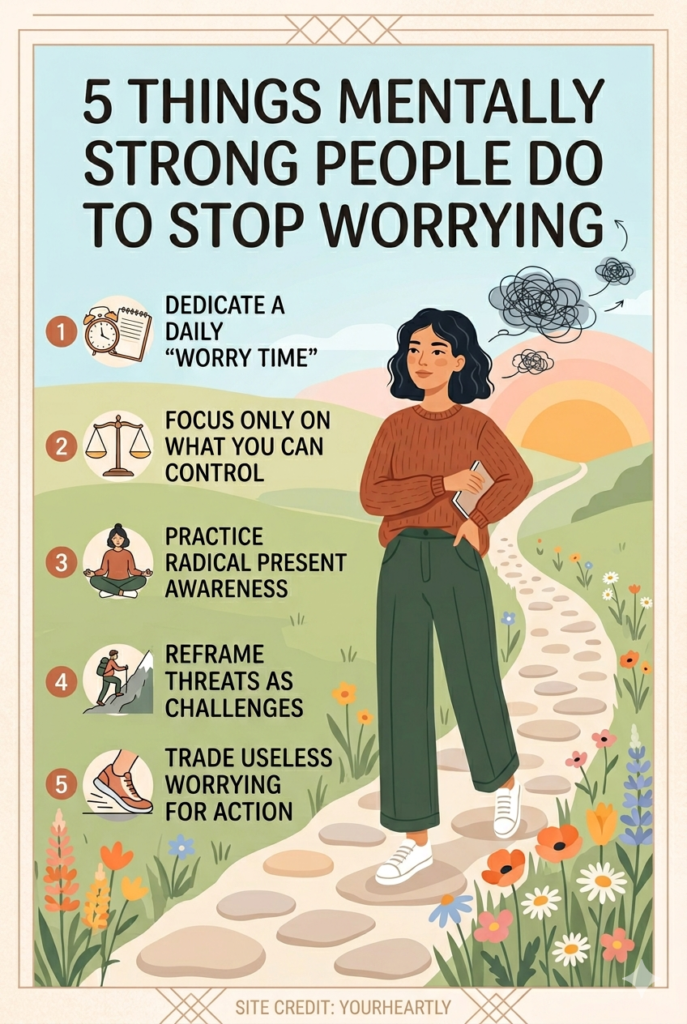
You can absolutely learn to train your brain to handle stress with that same level of calm, resilient strength. By shifting your daily perspective and adopting a few core habits, you can break free from the exhausting cycle of chronic overthinking. Let’s dive deep into the five primary things mentally strong people do consistently to protect their peace of mind and stop worrying for good.
1. Create a Dedicated Daily Worry Time
Mentally strong people do not try to completely banish anxious thoughts from their minds all day long.
They understand that fighting your thoughts directly only makes them return with double the original force.
Instead of fighting the tide, they schedule a specific fifteen-minute window each day exclusively for worrying.
You can set a timer for 4:00 PM and give yourself permission to feel all the anxiety you want.
During this designated period, you can write down every single fear and worst-case scenario that comes to mind.
You write freely without judging yourself or trying to fix any of the problems on the paper.
When the fifteen-minute timer goes off, you consciously close your notebook and step away from the desk.
If an anxious thought pops up at 10:00 AM, you gently remind yourself that it belongs in your afternoon worry window.
This simple boundary prevents anxiety from bleeding into your morning meetings, family dinners, and relaxing evenings.
You are teaching your brain that you are the one who decides when to pay attention to fear.
This practice keeps stress contained so it cannot consume your entire day or ruin your focus.
Over time, you will notice that many things that felt urgent in the morning seem silly by afternoon.
Your brain starts to realize that most of these hypothetical problems do not require immediate survival responses.
By containing your anxiety to a small box, you reclaim the rest of your precious day for living.
2. Separate Control from Lack of Control
You cannot control the global economy, the sudden rainy weather, or how your boss reacts to bad news.
Mentally strong people draw a very sharp line between what they can influence and what they cannot change.
They refuse to spend their limited mental energy trying to manipulate things outside of their direct personal reach.
When you feel a wave of worry coming on, you must immediately ask yourself what you can actually do.
If the problem is a giant rainstorm on your wedding day, you cannot force the sun to come out.
You can, however, buy a beautiful set of umbrellas and reserve a tent for the outdoor reception area.
Focusing entirely on your own actions gives you a powerful sense of agency in a chaotic world.
Worrying about things you cannot change is like sitting in a rocking chair expecting to move forward.
It keeps your body incredibly busy and exhausted without ever actually taking you anywhere near a real solution.
You must practice the difficult art of letting go of outcomes that rely entirely on other people.
When you catch yourself stressing over a colleague’s opinion, pivot your attention back to your own work quality.
Control your input, control your effort, and let the rest of the world unfold as it will.
This shift saves you thousands of hours of useless panic and protects your inner peace of mind.
You become a grounded anchor in the storm rather than a helpless leaf blown around by every breeze.
3. Practice Radical Present Moment Awareness
Worry is almost always a time traveler that drags your mind into a dark and unpredictable future.
Mentally strong people master the art of pulling their thoughts right back into the current physical room.
They use their physical senses to anchor themselves securely in the reality of the present moment.
When you feel your mind drifting toward future panic, look around you and name five things you see.
Listen closely to the room and identify three distinct sounds happening around you right now.
Feel the physical weight of your feet pressing firmly into the floor beneath your shoes.
Touch the cool surface of your desk or the soft fabric of your shirt to ground yourself.
This sensory exercise signals to your nervous system that you are currently safe right where you are.
The future you are dreading does not exist anywhere except inside your own imagination at this moment.
Right now, in this exact second, you are breathing and capable of handling this single moment.
You cannot solve next year’s problems today, so stop trying to live there ahead of time.
Treat your attention like a flashlight and shine it strictly on the step right in front of you.
When you live fully in the present, you realize that most moments are actually quite manageable.
This practice breaks the momentum of runaway thoughts before they turn into a full anxiety attack.
4. Reframe Threats as Manageable Challenges
The language you use inside your own head dictates how your body physically responds to stress.
Mentally strong people do not view every single unexpected twist of fate as an absolute catastrophe.
They consciously choose to view difficult situations as challenges to conquer rather than threats to fear.
When you face an upcoming presentation, your brain might tell you that you will surely fail miserably.
You can actively talk back to that inner critic and reframe the situation as an opportunity to grow.
Remind yourself of all the incredibly hard things you have already successfully survived in your past life.
You have a one hundred percent success rate of getting through your very worst days so far.
Instead of asking yourself what if everything goes wrong, ask yourself what if everything goes right.
Imagine yourself delivering the speech with confidence and receiving genuine applause from your peers.
If things do go slightly wrong, trust that you possess the creativity to figure out a solution.
You are shifting your mindset from a helpless victim to a capable and resourceful problem solver.
This subtle mental shift alters your brain chemistry from a state of paralyzing fear to active courage.
Challenges call forth your strength, while threats make you want to hide away from the world.
View your worries as hurdles that will ultimately make you a much wiser and stronger person.
5. Trade Useless Worrying for Immediate Action
Worry loves to disguise itself as a helpful tool for planning out your life.
It tricks you into believing that thinking about a problem over and over is the same as solving it.
Mentally strong people see right through this illusion and demand real action from themselves instead.
If a worry pops up, they immediately look for one tiny, imperfect step they can take right now.
If you are worried about your bank account balance, open your banking app and look at the numbers.
Create a very simple budget for the upcoming week based on your actual current financial reality.
If you are worried about your physical health, go outside and walk around the block for ten minutes.
Action is the ultimate antidote to the paralysis that chronic worry creates in your daily life.
Even the smallest step forward breaks the spell of fear and builds real momentum.
You stop overanalyzing the entire mountain and simply focus on moving one small stone today.
When you are actively working on a solution, your brain has less room to invent fake problems.
Replace the phrase “I don’t know what to do” with “I will try this one thing next.”
You do not need a perfect master plan to start moving away from your current state of anxiety.
Movement creates absolute clarity, while sitting still in your thoughts only breeds deeper self-doubt.
Choose to be a person of action rather than a passive collector of scary hypothetical scenarios.
Conclusion
Breaking free from the heavy chains of chronic worry requires time, patience, and consistent daily practice. You cannot expect to completely rewire your entire brain overnight after years of automatic overthinking habits. Mentally strong people understand that building emotional resilience is a lifelong journey of small choices. Every single time you redirect your thoughts back to the present moment, you are successfully strengthening your mind. You are proving to yourself that you possess the power to choose peace over internal chaos.
Remember to treat yourself with deep kindness and grace as you navigate this mental transition. It is completely natural for old habits to creep back in when you are feeling tired or stressed. When that happens, simply pause, take a deep breath, and apply one of these five proven strategies. Contain your anxiety within a worry time, focus on what you can control, and take one small action. You deserve to live a life filled with genuine joy, present-moment awareness, and deep mental clarity. Trust in your inner strength, embrace the beauty of today, and let go of the unpredictable future.