Have you ever caught yourself looking at a breathtakingly gorgeous woman and wondering what it must be like to walk in her shoes? It is incredibly easy to assume that life is an effortless breeze when you possess the kind of conventional beauty that turns heads the moment you enter a room. You might imagine that doors swing open automatically, problems dissolve instantly, and life is just a continuous stream of compliments and red carpets.
Society has conditioned us to believe that physical attractiveness is the ultimate golden ticket to a flawless, friction-free existence. We see polished images on our social feeds and assume that the women in them live completely charmed lives without a single worry. You see the smiles and the flawless style, but you rarely get to see the complex realities that exist right beneath the surface.
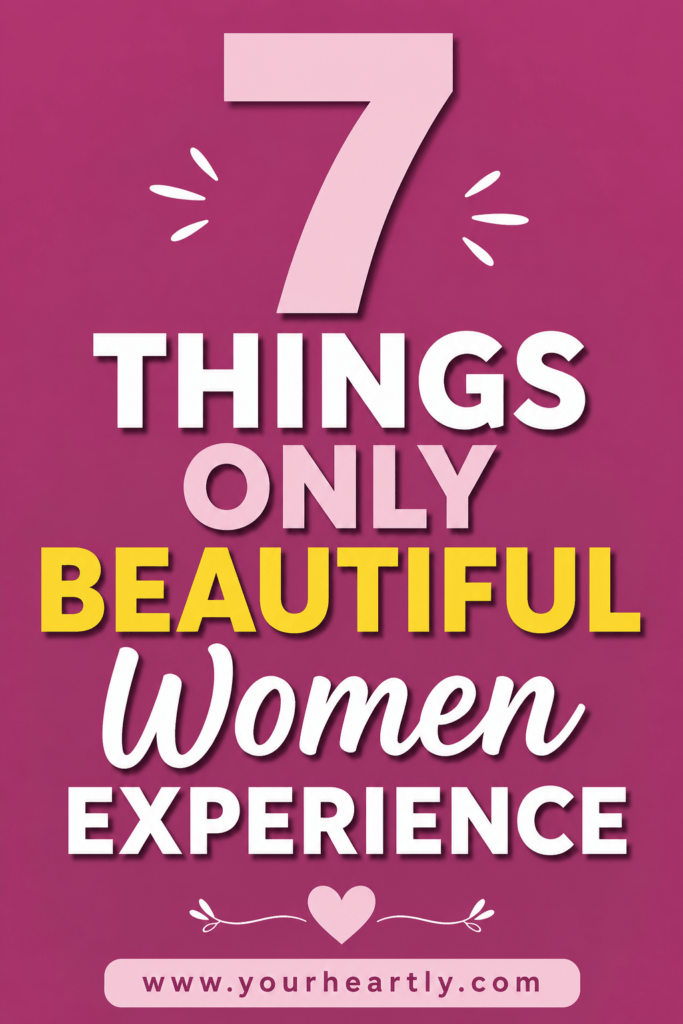
The truth is that hyper-attractiveness comes with a highly unique, often isolating set of challenges that standard beauty standards completely mask. There is a quiet, unspoken side to navigating the world when your appearance acts as a loud, constant introduction before you even speak a word. These experiences are rarely shared out loud because doing so often invites immediate skepticism, judgment, or accusations of humble bragging from others.
If you have ever felt the weight of these hidden dynamics, you are certainly not alone in navigating this beautifully complex territory. Let’s pull back the curtain and look at the actual realities of this experience, exploring the seven distinct things that highly beautiful women go through but almost never talk about.
The Immediate Skepticism of Your Intelligence
When you walk into a professional or academic setting, your appearance frequently creates an immediate, unspoken barrier to your credibility. People tend to assume that you have relied entirely on your looks to get into the room, rather than your intellect or hard work. You constantly have to over-prepare and over-deliver just to prove that you possess a sharp, capable mind beneath the polished surface.
This constant need to validate your brainpower can become an exhausting, never-ending cycle of performance in your daily life. You might find yourself intentionally toning down your style or avoiding makeup just to ensure your ideas are actually taken seriously. It creates a strange dynamic where you feel forced to minimize one part of yourself to let another part shine.
The frustration builds when you realize that your achievements are quietly minimized or chalked up to favoritism rather than your actual skills. Your late nights, dedication, and genuine talents are easily overshadowed by a stereotype that associates high beauty with superficiality. Navigating this requires a massive amount of mental resilience and an unwavering belief in your own intrinsic value.
The Loneliness of the Intimidation Barrier
You might notice that people frequently stare from a distance, yet very few individuals actually take the initiative to approach you. There is a widespread assumption that someone highly attractive must already be surrounded by friends, partners, and endless social options. Because of this misconception, people build an invisible wall of intimidation around you, assuming you are completely out of their league.
This paradox often leaves you sitting alone at social gatherings, wondering why everyone seems to be keeping their distance from you. It can lead to a deeply isolating experience where you are constantly surrounded by eyes but completely starved for genuine connection. The intimidating aura you cast is rarely intentional, yet it dictates how the world interacts with you daily.
Breaking through this barrier requires you to constantly be the one who smiles first, initiates conversations, and displays extreme vulnerability. If you do not actively work to appear soft and approachable, people will quickly label you as cold, stuck-up, or completely unapproachable. It places an unfair social burden on your shoulders just to put the people around you at ease.
The Hidden Thinness of Same-Sex Friendships
Building deep, unconditional bonds with other women can occasionally feel like navigating a minefield of unexpressed envy and constant comparison. Even within close friend groups, an undercurrent of competition can quietly distort the natural warmth of a supportive sisterhood. You may notice friends becoming suddenly distant when you receive attention, or making subtle, passive-aggressive remarks about your appearance.
This dynamic makes it incredibly difficult to find safe spaces where you can fully let your guard down without judgment. You might constantly worry that your presence is making your friends feel insecure or overshadowed during a night out together. It forces you to minimize your own updates, joy, and style just to protect the emotional comfort of others.
When a friendship fractures over these unspoken insecurities, the emotional pain is deeply felt and rarely understood by outsiders. You cannot easily vent about it because people will assume you are simply being vain or imagining the tension. It leaves you longing for genuine connections that are rooted in who you are, rather than how you look.
The Persistent Projection of Fluid Intentions
Every time you try to be kind, warm, or simply polite, people tend to misinterpret your basic friendliness as active flirtation. A simple smile to a barista or a helpful comment to a colleague can instantly be twisted into an invitation for romance. This constant misreading of your intentions forces you to become hyper-vigilant about every single social interaction you have.
You quickly learn to develop a guarded, neutral exterior just to protect yourself from sending the wrong signals to people. It feels restrictive because you have to actively suppress your natural warmth to avoid creating awkward, unwanted situations later on. You are forced to calculate your body language, tone of voice, and eye contact with mathematical precision.
When you inevitably have to clarify that you were just being nice, the reaction from the other person can be incredibly harsh. They may turn cold, accuse you of leading them on, or claim that you are leading people on for attention. This projection turns innocent, everyday human interactions into stressful moments that require constant boundary management.
The Erasure of Your Emotional Hardships
When you go through a difficult time, people often struggle to offer you genuine, deep empathy or meaningful emotional support. There is an toxic underlying belief that if you are beautiful, your life is automatically perfect and your pain is trivial. Friends might dismiss your heartbreaks, anxieties, or career struggles with comments about how easily you will bounce back.
This dismissal creates a painful environment where your real, human suffering is completely invalidated by the people around you. You are expected to be a smiling, flawless ornament who never experiences dark days, self-doubt, or emotional exhaustion. It forces you to internalize your struggles, dealing with heavy emotional weight completely behind closed doors.
The lack of a soft landing space can make you feel like you are viewed as a character rather than a person. People love the aesthetic of your life, but they rarely want to sit with the messy reality of your human emotions. You learn to hide your tears because you know the world rarely takes a beautiful woman’s pain seriously.
The Hyper-Scrutiny of Aging and Fluidity
From a very young age, you become acutely aware that the world places an immense, disproportionate value on your physical youth. This realization creates a quiet, lingering anxiety about the natural, inevitable process of aging and changing over the years. You feel a constant, heavy pressure to maintain a specific standard of perfection that is biologically impossible to keep forever.
Every tiny change in your appearance, from a new fine line to a shift in weight, feels magnified under a public microscope. People who grew accustomed to your peak beauty may make casual, cutting remarks about how you look tired or altered. This hyper-scrutiny turns the natural journey of growing older into a source of private stress and constant maintenance.
You are forced to navigate the complex realization that your social currency is tied to something completely fleeting and temporary. It requires deep inner work to detach your self-worth from your reflection and anchor it in your lasting values. The world rarely grants beautiful women the grace to age softly, naturally, and without endless public commentary.
The Constant Doubt of Romantic Authenticity
In the realm of romance, it is incredibly difficult to discern whether someone loves you for your soul or your surface. You often catch yourself wondering if your partner is truly enamored by your character, values, and quirks, or just your aesthetic. The fear of being treated as a trophy to be displayed, rather than a human to be cherished, is deeply real.
This doubt can make you hesitant to fully commit or trust the sweet words of a potential romantic partner early on. You watch closely to see if they stick around when you are messy, unfiltered, and completely stripped of your glamour. It takes a long time to feel secure that you are valued for the entity inside you.
When a relationship ends, the lingering question of whether they ever truly knew the real you can be incredibly haunting. You crave the kind of love that sees past the striking exterior and connects deeply with your quietest vulnerabilities. Finding that authentic alignment requires weeding through a sea of superficial attraction to find genuine, lasting devotion.
Navigating the world as a highly beautiful woman is a deeply nuanced experience that goes far beyond the surface-level perks society loves to highlight. While physical attractiveness undeniably grants certain societal privileges, it simultaneously introduces distinct emotional hurdles, social isolation, and constant skepticism. The true journey lies in learning to navigate these hidden dynamics while keeping your inner peace, authenticity, and self-worth entirely intact.
True confidence emerges when you stop allowing the external world’s projections—whether they are adoration, envy, or stereotype—to define your internal identity. By recognizing these unspoken challenges, you can begin to dismantle the pressure to be a flawless icon and simply allow yourself to be human. It is about embracing your physical self while ensuring your intellect, kindness, and character remain the loudest parts of your story.
Ultimately, your beauty is simply one single chapter of a much larger, incredibly rich, and deeply complex personal narrative. Surrounding yourself with people who see your soul, validate your mind, and support your emotional growth is absolutely essential. As you move forward, continue to own your space with grace, celebrate your multifaceted nature, and walk authentically in your unique truth.